
Understanding Certificate of Analysis (COA) Standards
Ensuring Quality and Transparency in Peptide Testing
At Pure Health Peptides, we recognize the importance of reliable and trustworthy products for research purposes. Our commitment to quality extends beyond our peptides to the meticulous processes we use to verify their integrity. By working closely with our partners and understanding key testing criteria, we ensure that our products meet the highest standards, setting us apart from others in the industry.
1. Why Are COAs Important?
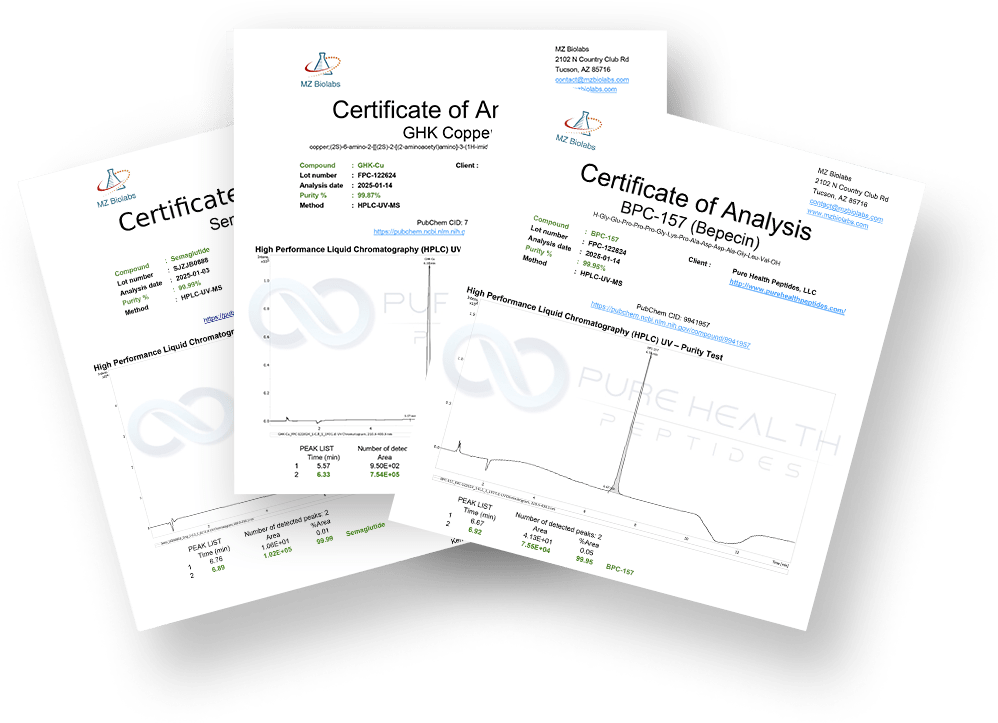
A Certificate of Analysis is a document that confirms the identity, purity, and quality of a peptide. It ensures that the product meets specific standards, making it critical for research integrity. Unfortunately, many COAs in the market are incomplete, lack critical data, or fail to meet industry standards, leaving researchers with unreliable results.
2. Differences Between High-End and Generic Testing
High-End Testing Methods and Equipment:
- HPLC (High-Performance Liquid Chromatography) – MZ Biolabs: HPLC is used by advanced laboratories to separate components of a peptide to detect even trace impurities with exceptional precision. Various detectors are used with HPLC including the popular UV detectors and mass spectrometers.
- UPLC (Ultra-Performance Liquid Chromatography) – Bio Regen
UPLC is an advanced chromatographic technique that builds on HPLC by offering:- Higher resolution and sharper peaks for enhanced impurity separation.
- Increased sensitivity, allowing for more precise low-level impurity detection.
- Faster analysis times, improving throughput while maintaining accuracy.
By incorporating both HPLC and UPLC methodologies, our testing partners ensure the highest level of analytical precision, setting a benchmark for peptide purity verification
- UV Radiation Testing: Both HPLC and UPLC use UV absorption technology to detect impurities in peptide formulations. Chromatograms generated from UV detectors provide a visual representation of compound separation, confirming purity levels and the presence of any contaminants.
- Mass Spectrometry (MS): Molecular Identity Confirmation
To further validate peptide composition, samples undergo mass spectrometry testing, ensuring molecular weights precisely match expected values. MS analysis, performed alongside HPLC or UPLC, confirms the authenticity and integrity of the compound.
Generic Testing Methods
Many low-cost-, non-standardized- or non-GMP certified peptide suppliers use outdated, generic methods that fail to ensure accuracy, leading to inconsistent or misleading purity claims by using generic methods, such as:
- Titration: A basic method for concentration determination, with limited ability to detect impurities.
- Infrared Spectroscopy (IR): Identifies molecular bonds but lacks precision for complex peptide analysis.
- Thin-Layer Chromatography (TLC): Useful for basic compound identification but inadequate for low-level impurity detection.
Processes and Procedures
- High-End Labs: Use sophisticated equipment, rigorous quality controls, and highly trained professionals. These ensure precision, reliability, and transparency in testing.
- Generic Labs: May rely on outdated techniques, simplified procedures, or limited expertise, increasing the risk of incomplete or inaccurate results.
3. How to Read and Interpret a COA
Key Data to Look For
- Testing Methodology: Verify that the COA specifies high-end methods like HPLC, UV radiation testing, and MS. These methods ensure the highest level of precision and reliability.
Purity - Percentage: Check for clear reporting of purity levels, ideally supported by chromatograms and impurity breakdowns.
- Chromatograms: Look for graphs that illustrate the separation of compounds, showing distinct peaks corresponding to the peptide being tested. Peaks should be labeled with time and area percentages.
- Identity Confirmation: Ensure the molecular weight of the compound matches the expected value. For example, mass spectrometry data should provide both expected and measured monoisotopic masses.
- Certifying Authority: Confirm that the COA is signed by a qualified chemist or analyst, adding credibility and accountability to the results.
Red Flags in a COA
- Missing or vague descriptions of testing methods.
- Lack of chromatograms or visual data supporting the purity claims.
- Discrepancies in reported purity percentages from different labs.
- Unsigned or undated certificates.
By thoroughly reviewing these key data points, researchers can ensure they are working with reliable products.
4. What Makes Pure Health Peptides Stand Out?
At Pure Health Peptides, we go the extra mile to ensure the quality and reliability of our products. Unlike others in the industry, we:
- Collaborate with MZ Biolabs and Bio Regen, both laboratories that meet the same high standards we uphold. Their use of advanced testing methods like UPLC, HPLC, UV, and MS ensures our products are tested with precision and transparency.
- Ensure all products are tested using advanced methods and include detailed data such as chromatograms, impurity breakdowns, and molecular confirmations.
- Proactively address industry challenges by prioritizing comprehensive and reliable certification processes.
We chose to partner with MZ Biolabs and Bio Regen, because their commitment to rigorous testing aligns with our values, and their standout practices mirror our dedication to delivering excellence.
5. How We Educate and Empower Researchers
To help researchers navigate the complexities of COAs and testing:
- We Share Insights: Using examples, we highlight what to look for in a COA, including key data points and common red flags.
- We Lead by Example: By ensuring our COAs are complete, transparent, and meet stringent criteria, we set a benchmark for the industry.
- We Advocate for Better Standards: Our commitment to understanding and addressing testing challenges positions us as a trusted partner in the research community.
6. Partnering for Excellence
By partnering with MZ Biolabs and Bio Regen, we ensure that our products are tested and certified to the highest standards. This collaboration reflects our shared commitment to quality, transparency, and reliability. At Pure Health Peptides, we don’t just provide peptides – we provide verifiable research quality.
Testing Process
Why testing matters

Identity
Is the peptide in the vial the peptide on the label?
Confirmed by HPLC-MS.

Purity
How much is the intended compound?
Quantified per lot.
Reported as a number.

Quantity
Does the vial contain what the label states? Mass verified, not estimated.

Quality
Was the batch produced through a clean, controlled, process? Each batch is tested for endotoxins and microbial contamination in accordance with USP <85>, <61>, and <62>.
Every batch. Every product. Published in the COA Library, retrievable by batch ID.
ISO/IeC 17025:
the gOlD stanDarD
Our testing partner is Ethos Analytics, accredited to ISO/IEC 17025 — the international standard for the technical competence of testing and calibration laboratories. Accreditation is granted by independent bodies after on-site assessment and is maintained through unannounced surveillance audits.
Most peptide vendors lean on chromatograms as their proof of testing. A chromatogram shows the test was performed. It doesn’t show whether the instrument was calibrated, the analyst qualified, the method validated, or the result reproducible.
ISO 17025 answers all of that before the test is ever run. Every step documented. Every procedure auditable. Every result traceable.

THE PURE HEALTH VERIFICATION PROCESS
Every batch follows a structured verification process designed to provide traceability, independent testing, and public transparency.
01
Supplier Qualification
Products are sourced exclusively from approved manufacturing partners selected according to predefined qualification standards, including manufacturing practices, consistency, and operational reliability.
02
Batch Identification
Each product and weight combination receives a unique Batch ID, creating a complete traceability record linking the batch to its supplier, production details, and testing history.
03
Independent Testing
Upon arrival, every batch undergoes physical inspection and three randomly selected vials are submitted to Ethos Analytics, our exclusive ISO/IEC 17025 accredited testing partner (Accreditation #: 117798 / License #: 000026LRCND60176649).
04
Qualification Review
Only batches that successfully meet all applicable testing criteria are approved for release and issued a Certificate of Analysis (COA).
05
Dual-Publication Verification
Approved COAs are published both by Ethos Analytics and within the Pure Health COA Library. This independent dual-publication model creates a transparent verification trail and helps safeguard the integrity of published analytical records.
06
Public COA Access
Lot-specific COAs remain publicly accessible through our online COA Library for the active life of the product, allowing researchers to independently review testing records before and after purchase.

A screenshot of a chromatogram may be visually appealing, but by itself, it has limited value from a quality and traceability standpoint.
Screenshots can be reused, cropped, or separated from the original data package, which means they do not independently demonstrate sample identity, method execution, instrument traceability, data integrity, or proper review.
ISO/IEC 17025 accreditation shows the system behind an outcome.
It demonstrates that the laboratory operates under defined requirements for technical competence, impartiality, documentation, equipment control, method execution, and result review.
In other words, the chromatogram supports the result, while accreditation supports the credibility of the process used to generate it.
— Nisrin Samsum
CEO, Ethos Analytics
HOw tO reaD yOur COA
When you open a COA from our library, here is what each field tells you and how to evaluate it.
01
Compound and CAS number
The compound name should match the product you ordered. The CAS number is a unique chemical identifier registered in the Chemical Abstracts Service database — the same CAS number is used by every supplier and lab worldwide for a given compound.
02
Batch / Lot Number
The unique identifier for the specific production run that yielded the material in your vial. The same identifier is printed vertically along the side of your product label.
03
Sample received and analysis conducted dates
When the lab received the sample and when the analysis was performed.
04
Analytical method
The techniques used — UHPLC-MS for identity and purity, LAL or rFC assay for endotoxin per USP <85>, petrifilm/qPCR for microbial limits per USP <61>/<62>.
05
Identity test
Specification and result. The result should read “Conforms.”
06
Quantity
Specification and measured result. Slight overages (e.g., 10.6 mg measured against a 10 mg label) are normal and expected.
07
Purity
Specification (e.g., ≥99%) and measured result (e.g., 99.82%). The measured purity typically exceeds the specification — the specification is the floor, not the target.
08
Endotoxin
Specification (typically expressed as an upper limit in EU/mg) and measured result. The result should fall below the specification limit.
09
Microbial limits
Specifications for total aerobic count, total combined yeasts and molds, and absence of specified pathogens (typically per USP <61>/<62>).
10
Chromatogram (when present)
Visual output from the HPLC or UHPLC analysis. Under ISO 17025 accreditation, the institutional documentation framework guarantees the rigor of every test; the chromatogram is supporting analytical evidence rather than the primary proof. Ethos Analytics COAs report results in summary form, with the full chromatographic data retained as part of the lab’s documented record.
ReD flags in a COA
When evaluating a COA from any supplier, the following are warning signs:
01
No accreditation status disclosed for the issuing laboratory
This is the single most important red flag. A COA from a non-accredited lab is a self-issued document with no independent oversight of the methodology behind it.
02
Missing or vague description of the analytical method
A reliable COA names the specific technique used (e.g., UHPLC-MS, HPLC-UV, LAL assay) and describes the conditions of analysis.
03
No identity confirmation
Some COAs report only purity percentage, with no separate test confirming that the compound being measured is actually the labeled compound. Purity is meaningless if identity is unverified.
04
Discrepancies in reported purity across labs or batches without explanation
Some variation between batches is normal; substantial unexplained variation suggests inconsistent methodology.
05
Unsigned or undated certificates
A COA should clearly identify the issuing lab, the analyst or certifying authority, and the date of analysis.
06
Inconsistent batch identifiers
The batch number on the COA should match the batch number on the product label.
07
No supply-chain testing on a lyophilized vialed product
For chemically synthesized lyophilized peptides, the standard appropriate panel includes endotoxin and microbial limits alongside identity, purity, and quantity. A COA that reports only the first three for a lyophilized vialed product is missing the supply-chain defense layer.
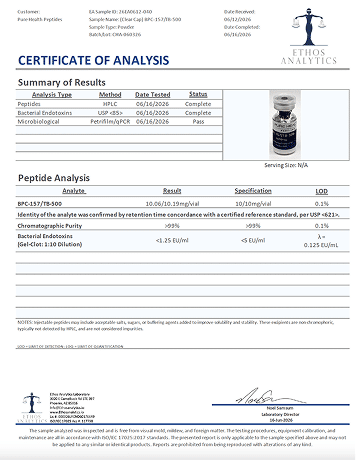
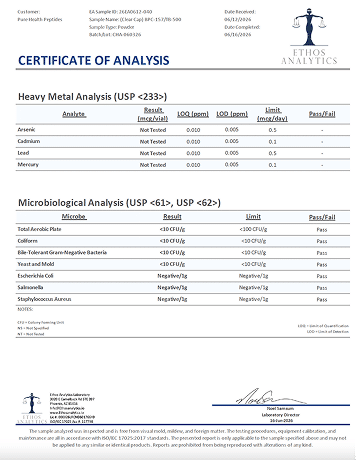

More tests on a COA do not necessarily mean better testing. The real measure is whether the tests performed are relevant, scientifically justified and appropriate for verifying the material produced.
— Nisrin Samsum
CEO, Ethos Analytics
HOw testing cOnnects tO manufacturing
Testing answers one half of the sourcing question — what is actually in the vial. The other half is where the material comes from and how it is made.
For the full picture of how Pure Health Peptides products are produced, including our domestic finishing operations and the chemical synthesis methods used to produce our peptides, see our Manufacturing Process page.
For verifiable batch-level proof of testing for any specific product you have received, search for your batch ID in the COA Library.
subscribe to newsletter
Be the first to know about new products & special
offers from Pure Health Peptides!